Showing posts with label SEONEWS. Show all posts

Tuesday, 28 July 2015

Connect Your Google+ Business Page To Your Google Maps Listing

Following steps to merge your pages:- 

1. Log in to Google+, open the drop-down navigation ribbon on the left-hand side, and select Pages. Find your Local page, which will have a “Verified Local Business” shield, and click Manage this page.

2. Click Dashboard in the upper Right-hand corner to open the drop-down menu, and then click Settings.

3. Scroll down to the “Profile” section, near the bottom. There is a line that says: “This page is connected to Google Maps.” There is a button beneath that line that says Connect to a different page. Click it. (Note: if you are the Manager but not the Owner of your Local age, you will not see this button.)

4. A dialogue box pops up that says [your location] is currently linked to [your local page]. There is a drop-down menu to select which page you want it to be linked to. Select your business page. (Note: if you are the Manager but not the Owner of your Business page, it will not show up in the drop-down list.)

5. Click Next. You will see the list of changes (included above) that will occur on your pages.
That’s it! You will still have the two pages in your dashboard, but the “Backup of [business name]“ page can now be deleted.

Tuesday, 21 July 2015

5 Ways To Use What Consumers Want To Boost Local SEO Strategy

Local businesses have unique competitive advantages over larger brands, and columnist Wesley Young analyzes a study by Yodle to find ways to leverage them into an effective search strategy.


The business of local is enjoying a surge of growth, supported both by consumer demand and business interest. Small and medium-sized businesses (SMBs) have long been touted as the backbone of the economy. According to the U.S. Census Bureau’s most recent data (2012), businesses with fewer than 20 employees make up 90% of all employer businesses and produce $4 trillion in sales receipts.
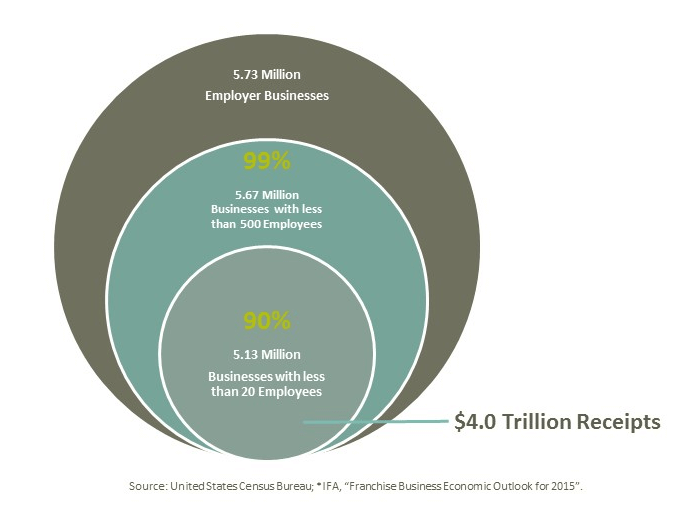
graphic 1 - smb circles
But it is their future growth that has marketers taking notice. Local online marketing company Yodle released a report titled, “Yodle Insights: What Consumers Want from Local Businesses,” that surveyed more than 6,000 consumers.
Yodle found that 82% of US consumers use local businesses, and that they use them more than national chains. More importantly, 47% of consumers stated that they used local businesses more this year than last year, and 48% planned to use local businesses even more over the next 12 months. Virtually no one expressed that they would use local businesses less (1–2%).

This growth in consumer dollars spent locally is a huge opportunity for marketers to help small business. Yodle’s data on what consumers want from local businesses is key to understanding how to take advantage of this opportunity and market in a way that distinguishes local businesses in their areas of strength.

Yodle’s study reports that 42% of consumers use online reviews or social media to research a business online — and there is significant overlap and synergy among various media as consumers seek, discover and consider products and services. (For example, a search on Google for Chinese restaurants in Frisco, Texas, yields results from Yelp, Zomato, TripAdvisor, YellowPages.com and FourSquare.)

With that in mind, each of the following strategies should be part of your overall search marketing toolbox.

1. Highlight What Consumers Value About Local Businesses
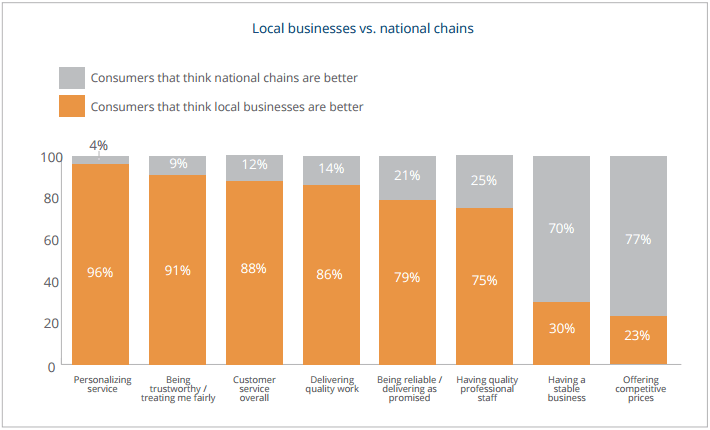
Consumers value local businesses for quality. They overwhelmingly chose local businesses over national chains for providing personalized service, delivering quality work, treating customers fairly and being reliable in delivering a product or service as promised.
Each of these business traits represents a competitive advantage local businesses have over those with larger, more recognizable brand names. One way to highlight these traits is to include language in search results that communicates them.

For example, for “kitchen remodeling” search results, include in the business description terms such as “customized designs,” “hand-cut stonework,” “quality remodeling,” or other terms that remind the consumer that delivering quality is an important factor when evaluating a business.

Another way to take advantage of this consumer perception is to emphasize the fact that your business is local. Since consumers already strongly believe local businesses have the above traits, attaching the local business tag to your store immediately identifies you as a business with high quality and personal service.

So include information in your meta descriptions, landing pages and business listings on other websites (e.g., Yelp) that emphasizes your local presence, such as address, neighborhood, maps and local area code.

Even national franchises can make sure that customers know the store is locally owned. Prominently include pictures of local owners and staff and use the term “locally owned” to help draw in some of the benefits of being identified as a local business.

2. Ask Customers To Provide Positive Reviews
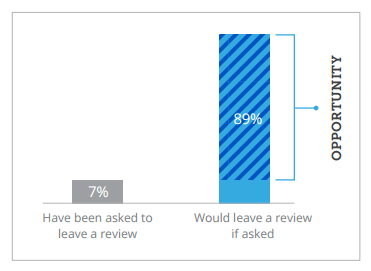
Yodle found that more than 75% of customers say that online reviews are important to their evaluation of a local business, with 40% expecting to see reviews and 36% believing it sets a local business apart from its competitors. What is most surprising is that almost 90% of consumers would leave a review if asked, yet only 7% have been asked.


While some businesses shy away from online reviews because of the fear that complainers are more vocal and likely to leave reviews, Yodle’s study found that 80% of customers posted reviews as the result of a positive experience with a business.

So local businesses are missing a huge opportunity for positive PR, content and reviews, all of which affect SEO and ranking. Do searches on your own business to find which sites with reviews pull up.
Taking the previous example of Chinese restaurants in Frisco, Texas, a local restaurant should monitor and seek reviews on Yelp, Zomato, TripAdvisor, YellowPages.com and FourSquare. Also, reviews are prominently used in map search results such as Google Maps.

3. Update Websites In Both Form & Content
Local Search Association (LSA) research shows that 50% of consumers state they are extremely likely to look at business websites when searching for a local business, the second highest source behind search engines — and 67% of consumers want improvements or mobile-optimized sites from those businesses, according to Yodle.

The importance of websites as a source of information is clear: Search results, online reviews or display ads contain limited information and often link back to the website, where more detailed information is available such as menus, prices, detailed service descriptions, staff qualifications and other information that consumers want to inform their buying decision.

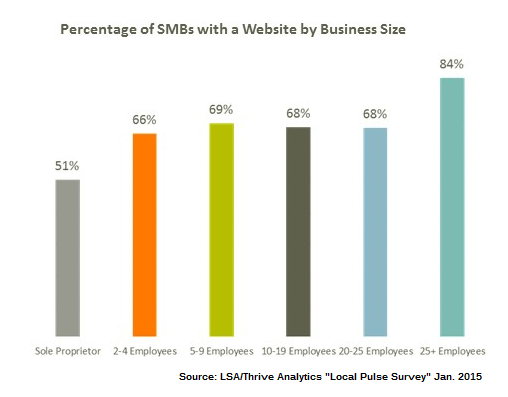
Of course, this assumes that you have a website. LSA’s Local Pulse Survey conducted by Thrive Analytics earlier this year revealed that only 51% of sole proprietors have websites. More than 30% of businesses with fewer than 25 employees still do not have a website.
graphic 4 smb websites
For those that do have a website, failing to maintain it — or treating it as a static asset — may be just as bad as not having one. Outdated or inaccurate information frustrates consumers and risks losing valuable customers.

Perhaps the highest profile example of problems outdated websites can cause was the case of Harvard professor Ben Edelman’s dispute about a $4 overcharge by a local restaurant. Edelman reported the restaurant to local authorities and threatened legal action. While Edelman’s boorish behavior backfired on him after the dispute went viral, the “overcharge” was the result of outdated menu prices on the website — he was correctly charged the newer prices on in-store menus.

According to LSA’s Local Pulse Survey, 56% of SMBs wait six months or more before updating their websites, and 60% are not optimized for mobile. Fresh content and mobile optimization not only help SEO, it’s what consumers want.

4. Use Offers & Deals To Compete On Price
The one big advantage national brands have is scale, which helps them offer lower prices. Yet it would seem that if prices were comparable, customers would choose what they believe to be higher quality local businesses.

On the other hand, significant price increases were rated as the number two reason that surveyed customers would stop using a local business, so setting temporary low prices to gain business just to raise them later is not a winning strategy.

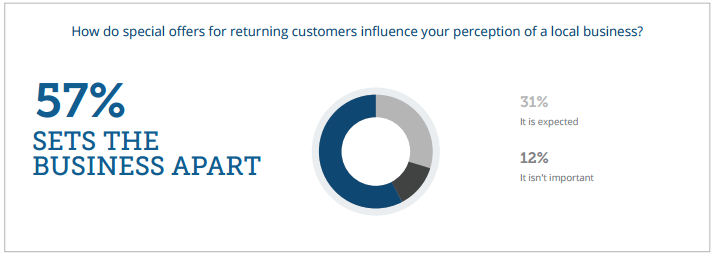
The solution may be to use offers and discounts. A whopping 88% of consumers in the Yodle survey want special offers for returning customers, with 57% saying it sets the business apart and 31% saying it is expected.
Discounts allow prices to remain at a sustainable level while providing temporary or one-time offers. These offers draw in customers to experience a local business’ quality and service.
Offers and discounts are particularly effective for mobile advertising. Consumers using mobile devices to find local businesses are often on-the-go and ready to buy, and limited-time discounts offered during their search will help motivate purchases.

Thrive Analytics’ 2015 Local Search Report for LSA found that 50% of consumers who clicked on a mobile ad and made a purchase did so because the ad offered an attractive deal or discount.
Use of offers or discounts in search engine listings, display ads, landing pages and other search results was the biggest factor consumers in the Yodle study said differentiates local businesses from the competition.

5. Email Customers To Keep The Business Top Of Mind
Another area of opportunity that local businesses aren’t taking full advantage of is communicating with existing customers. Good communication with existing customers can stand in for brand reputation and management.

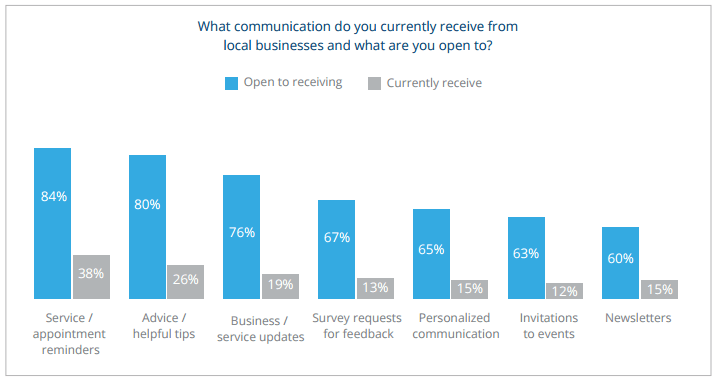
There are many reasons that justify reaching out to consumers: appointment reminders, the aforementioned deals and discounts, timely advice such as seasonal gardening tips, promotion of events, new services, and generally helpful news. Luckily, customers are open to receiving these communications, as the following chart from Yodle illustrates.
Source: Yodle Insights: What Consumers Want From Local Businesses
                     Source: Yodle Insights: What Consumers Want From Local Businesses
Businesses often cite lack of time and resources as reasons why they fail to engage in such communications. However, almost 70% of the consumers surveyed preferred to receive email communications, as opposed to phone or mail, from businesses. Email and digital services such as online booking and payments can be kept simple and automated to reduce both the cost and time needed to manage them.

Regular emails will keep a local business top of mind so that when customers conduct searches, they are likely to use narrower or targeted keywords that ensure the business turns up in results.

Conclusion
Local businesses have many competitive advantages over big name brands that can help attract customers. Consumers also often prefer doing business with local merchants. Knowing what consumers want and appealing to those desires will help win them over.

The key is when consumers search for local products and services, the results and the following actions as they discover and consider local businesses all reinforce factors valued in local business. Communicate the advantages of doing business with a local business, and customers will keep coming back — and they’ll tell their neighbors, too!

Source: http://searchengineland.com/5-ways-use-consumers-want-boost-local-seo-strategy-225114

Friday, 10 July 2015

SEO Can’t Always Get What It Wants — Or Can It?

SEO doesn't exist in a vacuum. Contributor Erin Everhart shares tips for getting other company stakeholders on board to achieve SEO success.


Everyone can, and probably has, argued over what part of working in SEO is the hardest. From the frequent algorithm updates and never really knowing what Google is thinking to constantly explaining yourself to executives and fighting tooth and nail to correct our bad reputation, we have plenty of options to choose from.

Personally, my nomination for one of the most difficult challenges is managing the push and pull within organizations to ensure SEO gets the resources it needs to achieve results.

As an SEO, you don’t really “own” any one digital asset, but everything in digital has an impact on your organic search traffic. It’s a disturbing situation because when something changes — even if you have nothing to do with it and perhaps don’t even know about it — you’re still on the hook when your organic traffic tanks.

So, how do you work with other teams to get what you want?
First, a few generalities that apply to anyone you’re working with:
  1. Speak their language. Throwing out acronyms and industry jargon is going to leave your listeners confused.
  2. Compromise. Don’t come in guns blazing demanding it’s your way or no way. Being a good business partner requires a bit of give and take so people actually want to work with you again.
  3. Talk on their terms. The easiest way to get what you want is to show how it’s actually going to benefit the other person. Focus on how whatever change will impact their KPIs, not just organic traffic.
Now that we’ve got the basics covered, how can SEOs work with specific departments so everyone gets what they want?
C-Suite
Company adoption of SEO ultimately comes from the top down; if your C-suite is on board and understands the value, you’ll have an easier time working in the weeds with the people who actually make the changes.

To do that, prove the value of SEO without drowning them in data. We have tons of metrics at our beck and call, but, in most cases, the only numbers C-suites really care about are traffic and revenue. Focus on overall business impact, not just how what you’re proposing affects organic traffic and revenue.
You’ll make even more impact if you can show competitors gaining more market share, because no C-suite wants to be second place to direct competition.
UX/Design Department
Designers don’t want to compromise their design for SEO, and they don’t want to design something solely for search engines. And rightfully so. Your site should first and foremost serve the needs of your users, but too often we’re forgetting that search engines are primary users of your site — probably the biggest ones in terms of how many times they access your site.

Each time you speak with your design team, watch your wording: Avoid things like “designing for SEO” or “building it for bots” because you’re only perpetuating the stereotype that SEOs don’t care about users.

The likeliest chance of conflict comes over content. Everyone knows you need live text on your web pages if you expect them to rank, but the design argument is that users don’t read content, and all it does is push down the important stuff (images, products, CTAs) that’s aimed at spurring people to make a purchasing decision.

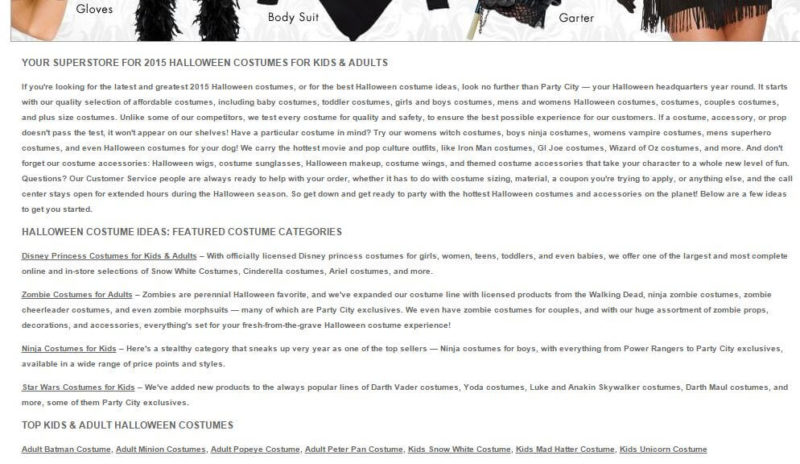
The most popular compromise is the eyesore of a content block at the bottom of a page.

Sure, great for SEO, but this is useless for everyone else.

Yeah, I’m sure everyone is reading this 11px sized font.
Sure, that content block is great for SEO, but it’s a sub-par user experience, and it’s definitely not the only way to rank for competitive terms. There are plenty of companies doing good design that have great SEO without that damned content block:
  • Otterbox ranks for “iPhone cases”
  • Target ranks for “bathing suits”
  • Best Buy ranks for “digital cameras”
The point is there are plenty of ways to to have well-designed engaging site that kicks butt in search engines, using things like web fonts, expandable divs, mouse-overs on images to show content, and small chunks of content scattered throughout the page rather than one large block at the end.

There’s no silver bullet solution, and what works for one site may not work for yours. Thankfully, designers love testing even more than SEOs, so approach your suggested changes not like, “This is what we have to do,” but more like, “Hey, I think this could help; let’s see how our users and search engines react.”
Present a couple of design options, put them out in the wild for six to eight weeks, and see what improves your positioning most while also increasing your overall engagement.
Copywriters
Whether you believe all SEOs should know how to write by themselves, or you rely on external copywriters, we all know SEO can’t exist without content. (Remember, content doesn’t have to be blog posts or marketing copy. Title tags and meta descriptions, two things which SEOs historically “own,” are pretty important content pieces for SEO, too.)

Copywriters are pretty much the sorcerers of today’s digital landscape as most everything that exists online includes some form of written content. It’s a primary driver for search engine rankings, and it’s the number one way users interact with brands, whether that involves content in emails, social posts, articles or product descriptions.

Copywriters are also always looking for things to write about, and that’s exactly where SEO steps in. SEOs have a pulse on what users are searching for and should be steering the content topics. That lifts some of the burden off the copywriters in coming up with the ideas, while also providing new organic entry points across your website.
Development & IT Teams
There are obvious elements that make for good SEO (like design and content), but there are even more nuances when you pull back the curtain and look at a site’s foundation. If your site isn’t built correctly, no amount of good design and quality content will bring you organic search visibility. Your developers are your lifelines, and you need to make sure you’re their favorite SEO.

This is the one team where speaking their language makes the most impact. Whether you’re working with network support or programmers, you’re interacting with highly specialized and highly technical people. If you’re not familiar with how websites are built and don’t understand the relevant jargon, you’ll get lost in their conversation.

You don’t have to physically know how to do it, but you better know how to clearly explain it. This makes a huge impact when you’re requesting work or putting in a JIRA story. Are all the requirements there? Did you note specifically where on the site you need the change to go? Will they be able to pick up the story and successfully complete the task without having to track you down for more information?

Even with the SEO and digital landscape changing every day, I don’t think there will ever be a time when we — not just SEOs, but anyone working in digital — can do our jobs in a silo. We’ll always have to rely on other teams to meet our KPIs. So, what’s worked for you? How have you been able to interact with other team members to do what’s best for the business and what’s best for SEO?

Source: http://searchengineland.com/seo-cant-always-get-wants-can-223953

Google Reports A 41% Growth In Mobile Searches For Movie Showtimes

According to a recent study, Google found 74% of moviegoers search online for showtimes, with 56% of the searches happening on mobile.

 
Google has put together a few figures sure to pique the interest of film promoters. According to Google’s data, the number of mobile searches on its site for movie showtimes has increased 41 percent so far this year.
With the help of market research firm Ipsos, Google used its search and movie trailer data from YouTube to see how consumers use Google to decide which movie to see see next.

The study found 74 percent of moviegoers search online to find showtimes, with 56 percent of searches related to movie tickets taking place on a mobile device.

Wednesday, 24 December 2014

Search Engine Land’s Top 10 News Stories Of 2014: When Pandas, Penguins & Pigeons Attack

We begin two weeks of year-in-review articles with a look at the most popular news stories we covered in 2014.

The clock is ticking on 2014. In a matter of days, we’ll all turn our calendars to 2015 and close the books on another year. Before we do that, the editorial team that brings you daily news and features on Search Engine Land and Marketing Land is going to look back at the most popular content we published during these past 12 months.

If you’re a new or recent reader, you’ll likely find some important news and commentary that you missed the first time around. If you’ve been reading our sites all year, you’ll hopefully enjoy a reminder of the year’s important marketing news. (And thanks for being a long-time reader!)

Over the next week two weeks, we’ll reveal our most popular columns (overall, and broken down by topic) and our most shared stories on the main social networks. But let’s start today with a look back at the most popular news stories we published in 2014.

Search Engine Land’s Most Popular News Stories Of 2014

This list is based on pageviews, and includes news stories published through December 18th.


Barry Schwartz, May 20: “Is this the softer and gentler Panda algorithm? From talking to Google, it sounds like this update will be gentler for some sites, and lay the groundwork for future changes in that direction.
“Google told us that Panda 4.0 affects different languages to different degrees. In English for example, the impact is ~7.5% of queries that are affected to a degree that a regular user might notice.”


Barry Schwartz, May 26: “Google made a slight change to their logo recently, as a Reddit user posted. The “g” in the latter part of the word was moved left one pixel and the “l” in the Google logo was moved down a pixel.”


Eric Enge, August 28: “The primary reason behind this shuffle of products is Google’s unswerving commitment to testing. Every product, and every change or innovation within each product, is constantly tested and evaluated. Anything that the data show as not meeting Google’s goals, not having sufficient user adoption, or not providing significant user value, will get the axe.”


Danny Sullivan, September 25: “The rollout means anyone who was penalized by Panda in the last update has a chance to emerge, if they made the right changes. So if you were hit by Panda, made alterations to your site, you’ll know by the end of next week if those were good enough, if you see an increase in traffic.
“The rollout also means that new sites not previously hit by Panda might get impacted. If you’ve seen a sudden traffic drop from Google this week, or note one in the coming days, then this latest Panda Update is likely to blame.”


Barry Schwartz, October 19: “Publishers hit by the last version of Penguin — back in October 2013 — have been waiting until now to see if actions they’re tried such as removing spammy links have worked. If so, they’re likely seeing some improvement in traffic this weekend. If not, they have to try making more changes and then waiting until however long it takes for Google to release Penguin again.

“By the way, for those who tried disavowing bad links, if you did that within the last three weeks, that was too late for this Penguin update.”


Barry Schwartz, July 24: “Google told us that the new local search algorithm ties deeper into their web search capabilities, including the hundreds of ranking signals they use in web search along with search features such as Knowledge Graph, spelling correction, synonyms and more.

“In addition, Google said that this new algorithm improves their distance and location ranking parameters.”


Danny Sullivan, February 6: “If you had any doubts over how Google feels about Russia’s legislation against gay “propaganda,” just go the Google home page. The company has started what will be a string of special logos for the Olympics with one that includes a quote stressing that the official Olympic Charter is against discrimination and using the colors of the rainbow gay pride flag.”


Danny Sullivan, June 2: “This is a big new integration for Bing, which last year knocked Google out of Siri. Currently, Spotlight offers a “Web Searches” option which launches Safari (if you haven’t changed your default browser), which in turn runs a Google search, as Google is the default on Safari.”


Danny Sullivan, March 26: “More broadly, while it’s easy to dismiss all this as some type of SEO squawking, it should be pretty disturbing to any publisher that Google might fairly broadly decide just how narrow your site has to be, in order to escape a penalty, if you have guest authors it deems writing off-topic.”


Barry Schwartz, May 21: “Yesterday, Google began rolling out their Panda 4.0 update designed to punch low-quality content. That’s generated both “winners” who have moved up in rankings as “losers” have dropped down — and eBay might be one of the big losers.”

With just a couple exceptions, the top 10 articles are specifically about Google rankings, algorithms and search results — which is no surprise. Last year’s list was 100 percent Google-related, and also filled with articles about Google’s various animal-related algorithm updates/filters. If you need a refresher on those beyond the articles linked above, see our article library to get caught up:

We’ve also compiled a similar list on our sister site, Marketing Land: Marketing Land’s Top 10 News Stories Of 2014: Facebook Layout Changes, Oscar Selfies, CIA Tweets & More.

On behalf of the Search Engine Land editorial team, thanks for reading us during 2014. Happy holidays to you and best wishes for 2015!

Source Of: http://searchengineland.com/sel-top-10-news-stories-of-2014-211443

2014 Year In Review: A Look Back On What Happened With SEO

Columnist Erin Everhart provides a round-up of the biggest SEO developments of 2014.
Every year, we say how much has changed in the industry – and every year, we’re right.

It never ceases to  amaze me how much SEO constantly refines itself to more sophisticated Google guidelines and smarter, savvier searchers. Think about it: Since 2011, Moz has counted more than 83 major algorithm updates to the search engine giant.

That’s 83 times we’ve had to change our tactics in three years! Can you think of any other industry that has gone through that much fluctuation? Unlikely.
So, as part of the end-of-year trends, let’s take a look back on everything that went down this in 2014.

January

Expedia was the first big brand of the year to get reportedly hit by a penalty for unnatural link building. Rankings plummeted, and Searchmetrics suggested the company lost 25% of its visibility in Google because of the penalty.

Matt Cutts put the hammer down on guest blogging, urging any SEO using this tactic as a way to build links to cease fire of suffer the consequences.
Rap Genius is finally back on Google after getting doled a manual penalty in late 2013 for link schemes.

Google announced a new Googlebot user-agent for crawling mobile content. “Googlebot-Mobile” was retired in place of the standard Googlebot, causing webmasters to update their robots.txt and technical structure of their site for mobile optimization.

February

In late 2013, Google moved to 100% secure search, thus taking all of our keyword data with it. By February, Not Provided had topped more than 80%.

March

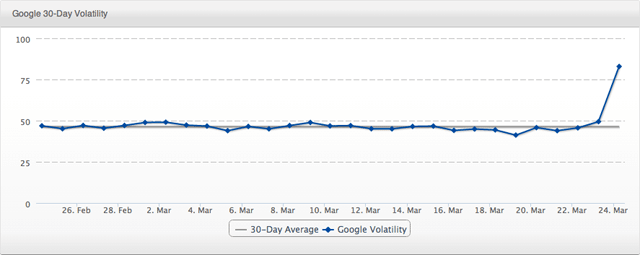
Webmasters started chatting about an update after seeing fluctuations in Google’s search results. Google never confirmed an update, but 
SERPs.com (among many others) noted a heavy increase in Google’s index volatility.
serps-march-1395837881
Google redesigned its SERPs for desktop users, removing underlined hyperlinks, increasing the font size slightly for title tags, and changing how ads are displayed.

April

The Heartbleed bug was revealed. Google, Rackspace, AWS and a host of security software used by millions of websites were affected, causing serious privacy concerns among anyone who uses the Internet.

Vic Gundotra, head of Google+ and Google’s social efforts, announced his departure from Google. Many questioned what this would mean for Google+ and its integration into organic search results. TechCrunch got word from multiple sources that Google+ will no longer be a product, but a platform, thus ending competition with Facebook and Twitter.

May

Panda 4.0 rolled out, the next wave in targeting sites with low quality content. Ask.com and RetailMeNot were among the big brands affected by the change.
eBay is the latest big brand to get hit by a (speculated) manual search engine penalty in addition to the Panda 4.0 update. eBay later suggested that this cost the business $200 million in revenue.

June

Authorship photos in SERPs listings were removed. Many questioned if this was the end to the entire program itself.

Google hosted its main event of the year, I/O 2014, where it announced news about the company and its future vision, including a new, consistent design across Chrome, Android and the web, an updated visual element to search, and wearables. You can read more about all the announcements at Verge.

July

Google added another animal to the algorithm apocalypse, releasing a local search algorithm update dubbed “Pigeon.” This update drastically changed which factors Google looks at when determining local rankings, including stronger ties to traditional web ranking signals.

Matt Cutts announced he was going on leave from Google, planning to return in October, and leaving his web spam duties behind. People panicked but were, on the whole, supportive.

Groupon ran a study showing that 60% of its direct traffic was actually organic search traffic, proving something many SEOs had long thought about their own “direct” traffic. Following that experiment, Conductor updated their 2013 study of web traffic, claiming that now 64% of all web traffic was from organic search.

August

Google announced that it would begin using HTTPS as a ranking signal, encouraging everyone to move from HTTP to HTTPS. This was seen as a sign that Google is trying to take this whole Internet privacy thing seriously.
We all saw this coming: Two months after the removed authorship photos, Google abandoned its Authorship program, which aimed to provide a stronger tie between content writers and content publishers.

The blogosphere was all abuzz over an influx of negative SEO extortion emails in which someone claimed they’d ruin your site’s rankings unless you wired them $XX amount of money.

September

Dentsu Aegis Network, a multinational media and digital communications company, acquired Covario, one of the largest search agencies in the United States. Rio SEO, Covario’s software business, was not a part of the deal.

Searchmetrics released their 2014 SEO Ranking Factors. High quality content, strong page architecture, and user signals saw the biggest increases in affecting ranking, while keyword links and social signals both decreased in value.

October

Authority Labs released one of the most comprehensive organic CTR studies. It segmented out desktop and mobile clicks, branded and non-branded keywords, and search intent (e.g. informational vs. transactional).

Google finally refreshed Penguin, the algorithm filter that targets web spam, over optimization and unnatural links. This was particularly noteworthy because it meant that everyone who was hit by the last Penguin and submitted a reconsideration request could finally get the opportunity to be reinstated into Google’s good graces.

Microsoft laid off Duane Forrester, Bing’s longest-serving face to the SEO community, not to mention the darling of the industry, having just won Search Personality of the Year.

Just a day later, Cutts decided Google web spam hadn’t crumbled in his absence and extended his time off until 2015. Speculations of a pending retirement ensued.

November

Google ditched its Local Carousel for hotels, restaurants, nightlight and entertainment. The SEO industry rejoiced.
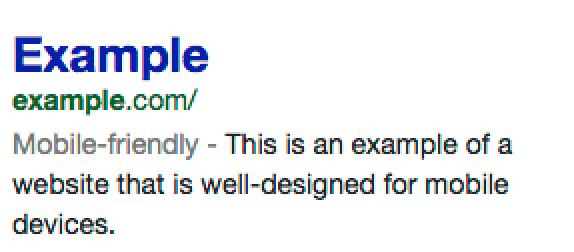
Mobile became even more important to SEO as Google rolled out the mobile-friendly search label for mobile search results and a mobile friendly test tool in Google Webmaster Tools. This was the beginning of Google experimenting with a new ranking algorithm for mobile friendly sites.
google-mobile-friendly-label

mobile-friendly-test

December

Bing released its version of Panda, and frankly, did a better job at outlining what it actually considers good content.
3-pillars-of-content-quality-800x110
Stone Temple Consulting released an extensive Twitter engagement study of more than 4 million tweets. One of the big findings was that time of day had little to no impact on “retweetability.”

What a year, right? I know I didn’t get it all, so what did I miss? What else monumental happened in 2015?

Source Of: http://searchengineland.com/2014-year-review-look-back-happened-seo-210959

Best SEO Tips And Tricks For 2015

Search Engine Optimization in 2015 is too complex for beginners so they must need to follow some Best SEO Tips and Tricks that will boost their Website ranking better in modern Search Engines.
So here we are going to see some Basic and Intermediate SEO Tips and Tricks that helps to improve your 3 important website ranking and also in Search Engine Results Page.
Below SEO tips and techniques are provided as per Google Best Practices and this cover most of the onpage factors.
Tips and Techniques for Keyword Analysis
The Below list will help to improve the Keyword Analysis better.
  1. Use this Google Keyword Planner for Keyword research
  2. Find Less Competitive Keywords with high search Volume
  3. Choose Key phrases
  4. List out Relative Keywords by relevance
Google Keyword Planner - Google Keyword Planner is the free SEO tool that is provided by Google and it helps to find out the Keywords search volume and relative Keyword ideas for you. Useful tool compare with other keyword analysis tool because Google is the top Search Engine used by people so it's worth to use this tool. Also use this 8 Free Google SEO Tools that help to Optimize your website
Less Competitive Keyword with high Search Volume - Finding this one is crucial part of SEO because if you find out this Keyword then you can get high search visitors. More competitor's means ranking high is also too much tough. So find out less completive Keywords.
Choose Key Phrases - Rather than selecting a single Keyword it's better chance to ranking more than one keyword if you chosen Key Phrases. So select Key phrases that works better compare to keywords.
List out Relative Keywords by relevance - List the relevant Searches and Keywords and use the words or phrase in the article going to publish in the blog for the selected keyword. This is going to help get ranking in more phrases than you targeted.
Excellent SEO Tips to improve On-Page optimization
Use this free top 10 wordpress SEO Plugins for better on-page seo for Wordpress blogs.
  1. Interesting and Descriptive to read
  2. Quality of the Content
  3. Short and Sweet Title
  4. Relative Meta Description
  5. Use this Optimal Keyword Density Ratio in content
  6. SEO Friendly Url
  7. Keywords in First Paragraph
  8. Use of Headings
  9. Focusing Keywords
  10. Image Optimization
Interesting and Descriptive article - No one is going to like boring long articles so write your content interest to read and descriptive content that will clear all things about the article title.
Quality of the Content - Don't copy Paste whole content from the other website that never going to bring you traffic. Google has very good eye to find out the Duplicate contents. Avoid Keyword stuffing and other Black-hat SEO tricks.
Shot and Sweet Title - Title must be relative and the Key phrase Keywords must be present in the Title. And in length is better to keep it between 40 to 65 Characters. To make website title tag to more search engine friendly read this Tips to optimize the title tag .
Relative Meta Description - Writ a short and sweet 156 Characters that will explain your whole story of the article will help to know better in Search Engines Results Page.
Optimal Keyword Density Ratio - Maintain your Keyword Density in the Safe manner to not getting Google Algorithm Penalties.
SEO Friendly URL - Url of the content must be meaning full to the content. Then search Engine highlight the Url Keywords also it's a boosting signal for the SEO.
Keyword in First Paragraph - Use the Keywords in First Paragraph so search Engines know this is the content really explains about the Title.
Use of Headings - Use prober headings tags h1, h2, etc... It will make readability easier and Nice Chapter wise content.
Focusing Keywords - Highlighting the Keyword with strong or em tag will increase the visibility of the point you are really want to reader by people also it's add some weight in SEO.
Image Optimization - One Image can explain everything better than long story content so add an image and Optimize image using proper Alt Tags.
Tips to improve Off-Page SEO
  1. Use of Social Media
  2. Quality Link Building
Use of Social Media - Use of Social Media not going to build follow back links but it's a powerful source to deliver traffic to the website. Traffic signal is also important factor in SEO so use the social media to get traffic.
Quality Link Building - Don't build your Link too much faster. Quantity of Back links that's not matter Quality will Matter. So write your articles good and interesting then the Back link will flow automatically to your content.
Useful SEO Tricks for 2015
  1. Find LSI Keywords
  2. Use LSI Keywords more
  3. SEO Check Up
Find LSI Keywords - Find the Latent Semantic Indexing Keywords related to your keywords using different methods available in the internet.
Use LSI Keywords more - Rather than Keyword stuffing the new idea use mixes it up LSI Keywords with Keywords as Keyword Stuffing. Use it in all important On-Page SEO Factors.
SEO Check Up - Take SEO Check Up and using different tools available in the Internet and improve the SEO Score by fixing by the tips then you can get a better rank in SERP.
Add a Bookmark of this Page above Tricks will be updated in regular manner to maintain the Quality of the Article.
Necessaries of SEO Tips and Tricks in 2015
Competitive world everything will have some Guidelines and rules that must we need to follow. So we need to follow this techniques to survive our ranking in search Engines.
Always one thing we need to remember in SEO that is if we write Unique and Good Articles that is interest to read for a user not for search engines this is the one rule always survives you in SERP.
Hope this SEO Tips and Tricks will helps to boost your rank in Google in 2015.
Source Of: http://googlexpres.blogspot.in/2014/12/seo-tips-and-tricks-for-2015-googlexpres.html


Copyright @ 2013 SEO Professional.

Real Time Analytics