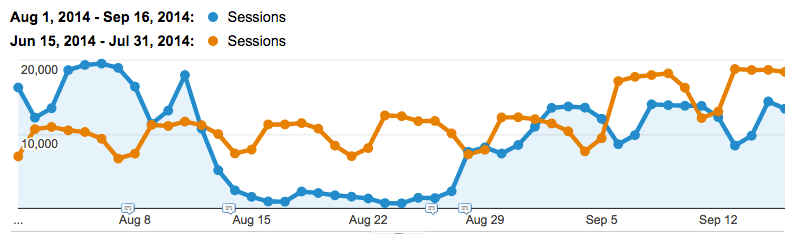
Buffer saw a 90% drop in Google traffic but recovered after Google fixed an unconfirmed bug.
Buffer’s Courtney Seiter posted
on the Buffer blog that they had an unusual Google Penalty that
resulted in a 90% drop in organic Google traffic to the site. The issue
had nothing to do with the Buffer web site, but rather a bug with
Google, according to Courtney.
Courtney said they noticed after the traffic drop that there was a
manual action penalty listed in Google Webmaster Tools. But the manual
action didn’t seem right, so Buffer and Joe Hall,
the SEO they hired, reached out to Google’s John Mueller who reportedly
told them it was an issue with Google and they fixed the issue after it
was reported to them. So Buffer didn’t have to make any changes or fix
any SEO related penalties, despite the manual action.
Courtney wrote:
Thankfully, our mystery has a happy—though slightly
inconclusive—ending. Mueller’s team at Google found an issue and let us
know they had fixed it. The manual action penalty was removed Aug. 28
and we began to see signs of recovery immediately after.
Here are graphs showing the huge drop in traffic; the first a
comparison and the second, showing the drop and recovery over time:
This would not be the first time Google a Google mistake either via
their algorithms or manual actions have led to huge traffic drops for
publishers. Back in 2012, Google has a bug with their parked domains classifier that resulted in sites dropping out of the index. More recently, Google confirmed MetaFilter was hit
by an undisclosed algorithm that impacted the site’s rankings for
years. Google made some adjustments over the past few months and their
rankings have appeared to return.
The interesting part is that the Buffer case had two points:
(1) The traffic drop was around the same time as the HTTPS migration
they went through. Although, Buffer believes the traffic drop had
nothing to do with the HTTPS migration.
(2) This was a manual action that required a team of Googlers to fix,
to bring Buffer back in their good graces. Aren’t manual actions
manual, and not algorithmic or automated?
Courtney told me that the manual action was not dated, so it is hard
for her to know if the manual action was related to the traffic drop or
not.
Now, it is 100% possible that the traffic drop had nothing to do with
HTTPS or the manual action. We have reached out to Google for a
comment to clarify the issue here.
Google actively working to make sure Views "Supports the needs of the community."
Googler Evan Rapoport announced this week that Google would be closing Panoramio, the geolocation photo site that lets users upload photos to Google Maps and Google Earth.
In place of Panoramio, Google will be migrating photos to its Google
Maps Views platform. In an interview with CNET, Rapoport said Panoramio
didn’t have a wide enough selection of photos.
“We need to be able to share more than just photos of landscapes and seascapes,” Rapoport told CNET, “Panoramio has done an amazing job, but we need to broaden that.”
Google did not give a definitive date for when Panoramio will close,
but did claim it will make sure, “Views reaches a level of feature
maturity that supports the needs of the community.” Rapoport admitted
Views hasn’t reached that point yet, and that Google is actively working
to address problems currently being reported.
According to this Google Product Forum,
users currently are having issues with their photos not uploading to
Views or being shared in Google Maps. After a Google Community Manager
started the forum to announce photos with locations that are shared
publicly on Google+ will appear in Views, one user reported photos not
showing up.
Another user claimed, “I’ve published several images over the past
couple of weeks but they haven’t shown up on the map at all.” Other
users commented on their concern over photos they have uploaded to their
Google+ account that include locations being shared on Google Maps when
they don’t want them there.
Since the original post by the Google Community Manager last Friday,
there has not been any responses to user comments and questions.
Strategically placed content is crucial for driving B2B leads; but without optimizing for search, you won't get the most juice.
Dear Content Marketers,
Have I told you (lately) that I love you?
Seriously! Content marketing has taken the elusive concept of
“thought leadership” and transformed it into a prescriptive, clear-cut
process. You equip prospects with the helpful information they need and,
at the same time, deliver quality, high-value leads for your companies.
But friends (we’re friends, right?), can we be content marketers who
are also savvy about our SEO? Can we squeeze a few more delicious drops
out of all our content efforts? Can we be brave enough to look back and
honestly ask, “Did I get all of the possible SEO benefit out of my
content?”
As someone seated in the intersection of SEO and content, I want to
make sure my content marketing friends aren’t missing any (or, dare I
say, all) of these often-missed SEO opportunities.
Mistake #1: Gate All The Content!
I know you know this, but it has to be said: Gated content has
minimal SEO value. (You’ve heard it before, but you’re still gating most
of your content. Yeah, I’m looking at you, and you know who you are.)
There are good reasons and solid benefits to gating content — from
collecting leads to implying value — and initially it seems unwise to
give away so much of your knowledge, research, and insight “for free.”
But there are also huge benefits to sharing as much information, and as
many resources, as you can.
None of that matters, however, if buyers don’t find your site in the
first place. If bots can’t index your best content, because it’s all
tucked away behind forms, they can’t rank your site as highly as it
deserves, and your rank is Step 1 for getting new audience members into
your funnel.
If you’re not on the first page, just forget about it. There are too many SEO implications
involved to justify trying to gate all of your content. I’m begging
you: Build a smart keyword strategy and deploy awesome, ungated content
to make it happen.
Mistake #2: PDF Content Can Only Be PDF Content
Congratulations: you’ve created a deep, insightful, stunningly
beautiful, gated PDF, and it’s getting tons of downloads. Well done!
It’s tempting to pat yourself on the back, move on to the next PDF, and
keep all of that hard work exclusive to the document.
But what if your e-book material can be taken one step further to
provide additional value, and draw more SEO traffic? There are many
opportunities to create (ungated) keyword-themed content that spins off
of gated PDFs, including:
Rewrite one chapter from your PDF — maybe thin it down — and make it a blog post.
Repurpose the main points and some key quotes/stats as a SlideShare or Checklist.
Create a YouTube video summarizing the content of the PDF.
(If you don’t have professional video capabilities, consider using
recordings from webinars/conferences or even Animoto, as appropriate.)
If your PDF has a unique visual theme, use that same theme to increase the visual appeal of related resource/article pages.
And if each of the spin-off content assets link back to the PDF, you will drive even more downloads.
Mistake #3: Keywords Are All About Keywords
Simply doing some cursory research and sprinkling a few keywords into your content is a waste of your time.
Google is hard at work improving their user experience, which is
directly impacting your content creation experience. User intent, even
inferred user intent, is shifting the way websites are ranked and what
results are delivered to each search at each IP.
In other words, Google isn’t a dumb robot just counting keywords and comparing keyword density.
Daunting as it initially appears, user intent is a potential gold mine
for content marketers. Analyzing the user intents for each keyword
you’re targeting can revolutionize your content strategy as you design
content for every combination of keyword + intent.
But if the content perks aren’t enticing enough, the SEO threat
should be. Google makes no secret of their continued effort to mine
audience information in order to deliver the best responses to every
search, and a lot of that has to do with their study of user intent.
Keywords are no longer just about key words.
Mistake #4: New eBook? No Big Deal
Maybe you do launch a new eBook every month. Maybe your audience
knows what to expect, and when. Or maybe you’ve spent so many hours
writing, editing, designing, and revising the thing that you’re just
ready to cut it loose and kiss it goodbye.
Not yet. You’re wasting a huge SEO opportunity!
Your eBook is awesome! (Even if it’s your 37th one!) Make a big deal
out of it. Build some anticipation, and build some SEO strategy at the
same time.
Create clean, shareable images and/or infographics based on your data.
Schedule a short series of blog posts leading up to the release.
Get key influencers involved in the eBook, and then reach out with content when it goes live.
Put together a snappy webinar to go live after the eBook is published.
Weave that eBook — its content and the simple fact of its existence —
into your brand narrative to tell its story. Then tell your brand
story, and then tell your audience how the eBook’s story is part of your
brand story.
You know how people enjoy and respond to narratives. The more your
narratives are out in the limelight, generating online activity and
building your audience, the more links, social and brand activity Google
sees, thus boosting your SEO profile.
Mistake #5: Content Is One-Sided
In addition to PDFs and eBooks, all of your content can serve more
than one goal. Instead of planning one article for a blog post to
attract inbound attention, a different study for a PDF that will
generate leads, and a separate media campaign to start conversations on
social, squeeze all of that value out of each piece of content.
Think about how each piece can do at least most of the following:
Drive downloads and new leads.
Earn social shares.
Attract SEO traffic
Build new prospects into your audience
Nurture your existing audience
A well researched and written blog post, for example, will be
designed for and targeted to a specific combination of keyword + user
intent to optimize organic traffic. Its data can be turned into an
infographic for the following week, or include a shareable image of a
profound/inspiring quote from the piece.
Finally, it should end with an unobtrusive call to action — a link to
download that eBook for more information, or links to other landing
pages or blog posts on either the current topic or the buyer’s next
step.
Best Of Both Worlds
Content marketing is the lifeblood of inbound, and inbound is driving
conversations in the new marketplace. Savvy marketers have done an
amazing job of responding to a buyers’ revolution in a relatively short
period of time.
The new face of internet marketing, however, doesn’t mean that
everything about traditional SEO is dead in the water. While traditional
SEO marketers need to be catching up to the strength and strategy of
inbound, new content marketers can still learn a thing or two from
modern SEO techniques.
Where the tools and techniques of SEO are thoughtfully applied to the
new philosophies of content and inbound, marketers will find a steady
stream of new targeted audience members and qualified buyers.
Local rankings are a dying metric, especially with
the fluctuations of Pigeon. So why not start reporting on metrics that
actually matter?
If you work in Local SEO, you’re already familiar with the Pigeon update
and the crazy effects it’s had on local search results. It’s painfully
obvious that the rankings are still fluctuating – but maybe that’s a
good thing.
Many SEOs have been calling for an end to monthly ranking reports for
quite a while now. Unfortunately, clients still see ranking reports as
the best indicator of SEO success.
Now that Pigeon has caused havoc with local rankings, we’ve got a
huge opportunity to take advantage of the flux and educate our clients
that rankings don’t equal success. All of the Local SEOs can band
together, rise up, and show our clients better reports with metrics that
really matter to the bottom line.
5 Local SEO Metrics You Should Focus On Instead Of Rankings
Contrary to popular belief, your monthly reports don’t have to be
complicated and show tons of data. In many cases, you could ditch your
complicated, 10-page report and instead provide two simple pages of
actionable data.
Here are 5 metrics that you should be tracking and including in your report to show the success of your Local SEO campaigns:
1. Organic Traffic
You’d be amazed at how many SEO reports are out there that don’t show
organic search traffic! Hopefully you’re already including this in your
reports, but if you’re not, stop reading and go add it in immediately.
There are two ways to get to this data. The first is to go to Acquisition > Channels, and then
look at “Organic Search.” This is the easiest method, but not
necessarily the most accurate by default – smaller search engines are
sometimes not included within “Organic Search” (they’ll instead be
counted as referrals), or you might have Google referrals that you’d
like to include within your organic search traffic. (Note: if you’re
using Universal Analytics, you can now identify any referrers as search
engines, but you have to set your analytics up in that manner.)
If you’re not using Universal Analytics but know there are sources
you’d like to count that wouldn’t show up under the standard Organic
Search report, you can check your numbers manually. Navigate to Acquisition > All Traffic and scan the Source/Medium column for organic search sources.
Pro Tip 1: If you’re going to use the second method,
you can build a simple spreadsheet that counts the results for you.
Create a range that lists all of the possible organic traffic sources
that might be listed, then set up a column that will use VLOOKUP to
check your traffic sources against the list. Export the list of traffic
sources, then paste them into the spreadsheet, and the totals will be
automatically calculated.
Pro Tip 2: Instead of simply showing monthly search
traffic in a graph or chart, compare your organic traffic to last year’s
organic traffic. Comparing month-to-month isn’t accurate in many
verticals due to seasonality, but when you compare year-over-year, you
get a better view of the traffic trends.
2. Organic Landing Pages
You know which pages are optimized for which keywords. Instead of
providing a report that shows how your pages are ranking, you should
report on which pages are actually receiving organic search traffic.
Go to Acquisition > All Traffic, then
select “google/organic” to isolate the visits from Google (or whichever
search engine you’re analyzing). Use the secondary dimension drop down
to show “Landing Page” (under Behavior) and you’ll have a nifty little
report that shows which pages get actual visits from Google.
Instead of showing what keywords you’re ranking for, you’re showing
which pages are actually getting search engine traffic. Since you know
which keywords each page is optimized for, you know which keywords are
bringing you the most traffic. If your local targeting is working, you
should see increased visits to SEO landing pages over time.
3. Organic Conversion Sources
This is another one that you’d think would be in every SEO report —
yet it’s missing from far too many. When your client wants to know about
the ROI of SEO, they’re asking you to show that the money they’re
spending on your services is making a difference to their bottom line.
Nothing speaks to the bottom line more than hard numbers on how many
leads your client gets.
Navigate to Conversions > Goals > Overview.
If you scroll down, the default view shows the Goal Completion
Locations, but if you click the “Source/Medium” option just underneath,
you’ll see a list of the top 10 sources for goal conversions. Track your
organic sources and make this one of the key metrics in your monthly
report.
Pro Tip: Create a custom report in Google Analytics
to show only organic search sources for goal completions. Again, you can
export the results and drop them into an Excel sheet that automatically
totals the numbers.
4. Google My Business Impressions
Google Webmaster Tools will give you impression data across keywords,
but if you log into your Google My Business (GMB) dashboard, the
Insights data will show impressions for just your GMB listing. Keep in
mind that the numbers shown are approximate — just like Webmaster Tools,
the data is filtered and meant more for a “big picture” view than exact
numbers. Even so, you’re still able to see trends over time.
Since map pack or Carousel views don’t necessarily lead to website
visits, it’s important to show your client how their GMB listing is
working for them. They might be getting phone calls or physical visits
from map pack views, which you can’t track in your reports – so showing
an increase in GMB impressions over time helps to prove ROI.
5. Clicks For Driving Directions
Again, values are approximate here, but it’s definitely a metric that
your clients will love. If a user is clicking over to driving
directions, you know that they’re planning on a physical visit —
and this is huge for local business owners. Track the number of driving
directions clicks over time to show an increase as your Local SEO
efforts give your client more visibility in more searches.
You can even look at some (extremely general) numbers of where the clicks for directions came from:
Now that Google is moving in a hyper-localized direction, this can
help to show where your customers are coming from. If you’re targeting
specific neighborhoods or suburbs of a metro area, you should be able to
see an increase from those zip codes when you track these numbers over
time.
Bonus Metric: Manual Phone Tracking
We all know that call tracking numbers are awful for local search,
but we’ve worked with several clients who’ve opted for manual tracking
and had great success. They’ve trained their staff to ask a simple
question at the end of every call: “If you don’t mind, how did you find
our number today?”
Almost 100% of the time, the caller is happy to tell them where the
call came from. The numbers are collected and relayed at the end of the
month, and we’re able to include inbound call data along with form
conversions. Again, if your Local SEO efforts are successful, you’ll see
an increase in calls from “the Internet” over time.
Deliver Reports With Metrics That Matter
Again, your reports should deliver metrics that matter to your
client’s bottom line – not pages and pages of data that they don’t care
about. We should use the Pigeon-induced insanity of local ranking
fluctuations to educate our clients and prove to them that they don’t
need ranking reports to prove ROI. Better reports with actionable data
will result in happier clients, which means job security for all of us. Source of:One Positive Pigeon Result: We Can Finally Ditch Ranking Reports
Like many of Google’s local/mapping products, My Maps has had a …
let’s call it a “checkered” history. It’s been heavily promoted and then
seemingly ignored. It’s been renamed (to “My Places”) and had some of
its features co-opted by other Google products. Perhaps most
importantly, it wasn’t supported in the new Google Maps that launched earlier this year.
So you might be happy to learn that My Maps is back. Google announced its return today.
This isn’t quite the same My Maps you might remember from years ago. It’s an update to the Google Maps Engine Lite
product that Google rolled out in early 2013. Back then, Google asked
My Maps users to import their maps into Maps Engine Lite, and promised
to eventually merge the two services. That’s now complete.
Visitors reaching the new My Maps
can begin immediately creating new maps, or they can go through a short
process of upgrading their older saved maps. (Google says all old maps
will be automatically upgraded by the end of the year.) After upgrading,
a new “My Maps” card is added under the Google Maps search box.
There’s a Google support page that details some of the new features that have been added to My Maps:
Just like with classic My Maps, you can save places,
driving directions, add photos and videos, and more. But it also has new
features:
Share your map like you do a Google Doc.
Use different colors to make parts of your map stand out.
Label your features directly on the map.
Import locations from a spreadsheet.
Organize your places with layers.
Many local businesses have used My Maps over the years as a marketing
tool. Uses ranged from simple things like creating a map of all of a
store’s/office’s locations, to more involved uses like creating a travel
guide for tourists. All of that is still possible with the new My Maps.
For power users — whether business or personal — Google offers a complementary My Maps Pro service. It costs $5 per month and offers additional tools for map making and a higher limit on daily views. Source of: Google Revives, Upgrades My Maps
Google expects Penguin 3.0 to launch within the 2014 year.
In 22 days from now, it will be the year anniversary of the release
of the fifth update to Google’s Penguin algorithm, code-named Penguin 2.1. As you can imagine, waiting 11 months and 8 days can be excruciating for those who were negatively impacted by the punitive algorithm.
They’ve likely by now cleaned up their links but they are still
sitting and hoping their businesses survive to see an improvement when
Google unleashes the next Penguin update.
Well, it might not be too far off. Google’s John Mueller said on a Google Hangout
this morning that he expects Penguin 3.0, which would be the 6th
refresh, to happen within the 2014 year. In fact, John said “I am
pretty confident we will have something in the reasonable future.”
What is the “reasonable future”? At this point, it is not reasonable
to go 11+ months without a refresh, but if I had to guess, I’d hope to
see one before the anniversary. I think that would be reasonable at this
point in time. But your guess is as good as mine.
We thought we saw Penguin updates before, but Google told us it was not a Penguin update. I definitely believe Google has been testing Penguin updates in the live index but again, they have not fully released it yet.
Penguin 3.0 is expected to be a major update, making the algorithm more capable of running more frequently so that those impacted wouldn’t have to wait too long before seeing a refresh. Something like how Panda is now run monthly.
Google has told us
their efforts to update the Penguin algorithm have been met with many
challenges. But it seems like we are finally getting to a point where we
will see a refresh of Penguin really soon.
As soon as we hear official word from Google on a release date and time, we will be the first to report it to you.
Did Google update Penguin or Panda algorithms? Your site is impacted by many algorithms says Google.
I personally spend a lot of time within the SEO space investigating
claims of Google algorithm updates; it is a fascinating topic because
there are so many variables involved and a lot of secrecy on Google’s
end around its search algorithms.
Often, Google will not confirm updates or algorithm refreshes. Plus,
with manual actions and link penalties happening all the time, it makes
it hard to determine if Google updated its ranking algorithms or if a
penalty was pushed out that impacted a large number of sites.
Recently, there have been many rumors around Google testing a Penguin refresh. Note, it has been almost a year since the last official Penguin refresh, aka Penguin 2.1, so webmasters are eager to see their sites released from the algorithm.
This past Friday, there reports from some sources of a Panda refresh. With Panda, we know Google won’t confirm
future updates, for the most part. But there is strong evidence to say
Google ran a refresh, which on average happens monthly these days.
This morning, I spotted an interesting post by Google’s John Mueller in a help thread
where John explains the complexities around Google’s algorithms. It is
important you all read what John wrote because Google’s search algorithm
is incredibly complex:
In theory: If a site is affected by any specific
algorithm or its data, and it fixes the issue that led to that
situation, then the algorithm and/or its data must be refreshed in order
to see those changes. Sometimes those changes aren’t immediately
visible even after a refresh, that’s normal too.
In practice, a site is never in a void alone with just a single
algorithm. We use over 200 factors in crawling, indexing, and ranking.
While there are some cases where a site is strongly affected by a single
algorithm, that doesn’t mean that it won’t see any changes until that
algorithm or its data is refreshed. For example, if a site is strongly
affected by a web-spam algorithm, and you resolve all of those web-spam
issues and work to make your site fantastic, you’re likely to see
changes in search even before that algorithm or its data is refreshed.
Some of those effects might be directly related to the changes you made
(other algorithms finding that your site is really much better), some of
them might be more indirect (users loving your updated site and
recommending it to others). So yes, in a theoretical void of just your site and a single algorithm
(and of course such a void doesn’t really exist!), you’d need to wait
for the algorithm and/or its data to refresh to see any changes based on
the new situation. In practice, however, things are much more involved,
and improvements that you make (especially significant ones) are likely
to have visible effects even outside of that single algorithm. One part
that helps to keep in mind here is that you shouldn’t be focusing on
individual factors of individual algorithms, it makes much more sense to
focus on your site overall — cleaning up individual issues, but not
assuming that these are the only aspects worth working on. All that said, we do realize that it would be great if we could speed
the refresh-cycle of some of these algorithms up a bit, and I know the
team is working on that. I know it can be frustrating to not see changes
after spending a lot of time to improve things. In the meantime, I’d
really recommend – as above – not focusing on any specific aspect of an
algorithm, and instead making sure that your site is (or becomes) the
absolute best of its kind by far.
Every year, SearchMetrics releases the study but this is the largest
study they’ve done, with almost 100 pages and by adding dozens of new
factors like time of site, bounce rate, fresh links and others.
The key take away from here is that content may now be truly king.
Marcus Tober from SearchMetrics said in the report that content is “no
longer an addition to, but is the main focus of, SEO .”
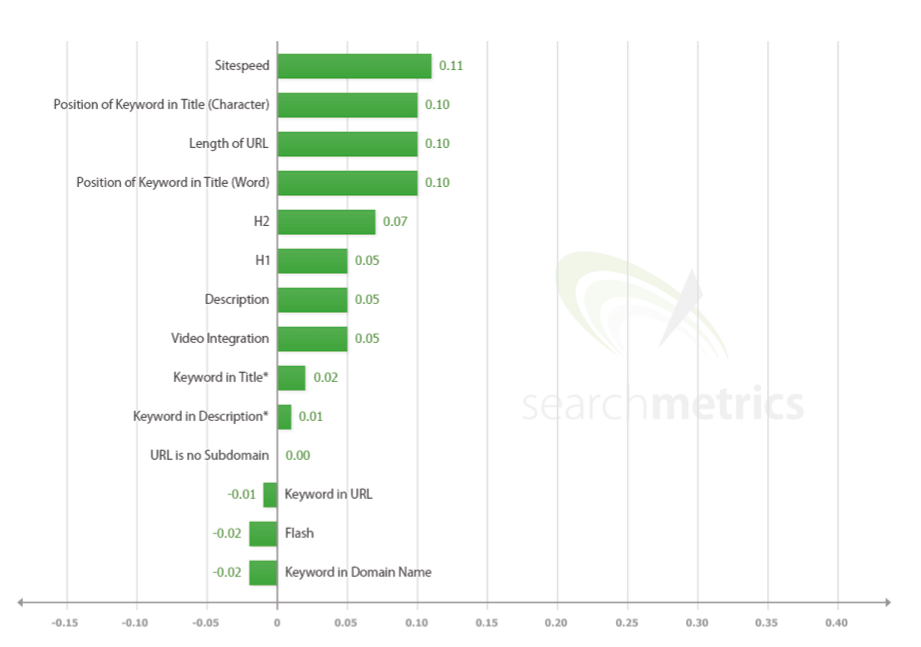
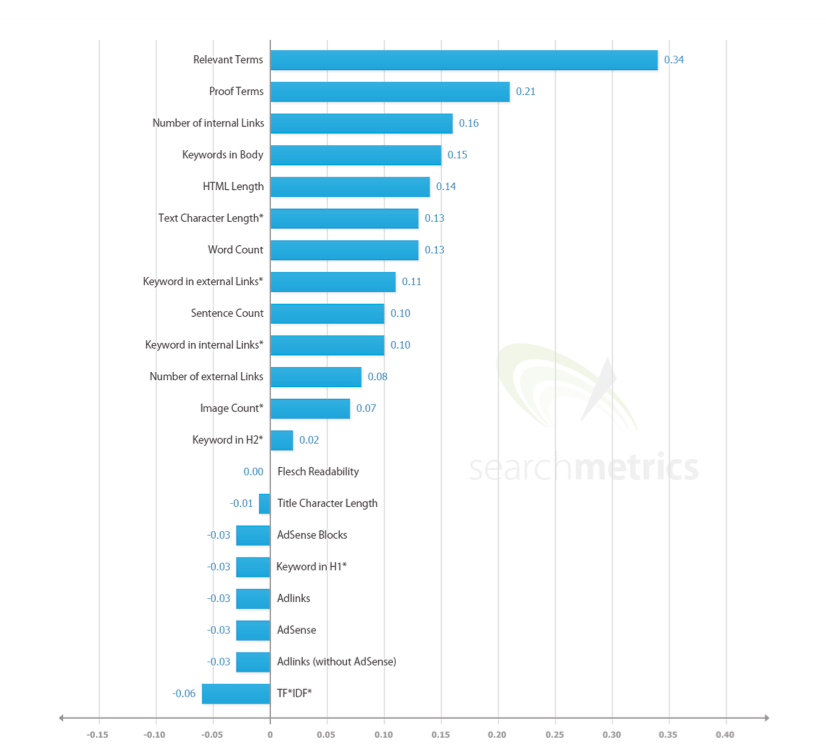
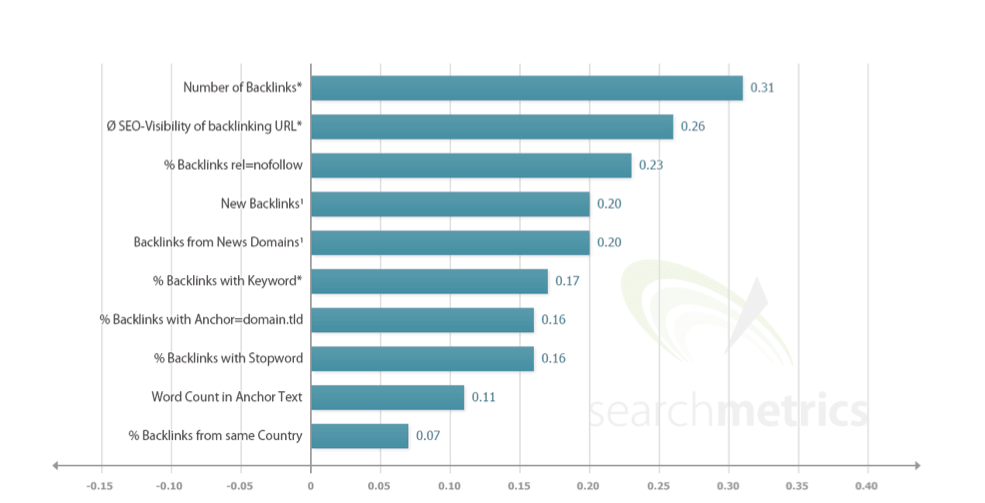
Here is a breakdown of the study with some charts showing parts of the analysis. But you can download the full report over here.
Content
There is a measurable correlation between the quality of content and
rankings. This is demonstrated by, among others, the analysis of two
new features based primarily on word co-occurrence analysis: Proof and
Relevant Terms.
The length of content continues to increase.
A good internal linking structure is an important factor, and probably the most underrated SEO measure.
Onpage Technical SEO
Onpage, the keyword remains an important part of the overall concept
for SEO, often represented by a balanced presence in Title,
Description, Body copy, H1, H2, etc. Needless to say, that keyword
stuffing should still be avoided. However, there is a definite trend
towards developing keywords to topics to generate holistic content.
Site load speed is a veryRF Robot important performance factor.
Good site architecture is the beginning and end of effective SEO.
Backlinks
The quantity and especially the quality of backlinks remains important.
The number of keyword backlinks continues to decrease, even if the correlation increases.
Backlink features for Brands (Point 6 below) appear to work differently to the rest of the URLs in SERPs.
Social Signals
There were minor changes to the previous year, with Social signals correlating slightly less with good rankings than last year.
Average values rose slightly.
User Signals
Both the click-through rate and the time-on-site are considerably
higher in better ranking sites – this may appear obvious, but average
values determined over many URLs can be used as a benchmark for your own
optimization.
The bounce rate is lower for top-ranking URLs.
Brand Factor
There seem to be special consideration for big brands.
The Brand Factor and its definition have been revised this year, to show the increasing complexity of its influence and quality.
Google has completely dropped all authorship functionality from the search results and webmaster tools.
After three years the great Google Authorship experiment has come to an end … at least for now.
Today John Mueller of Google Webmaster Tools announced in a Google+ post
that Google will stop showing authorship results in Google Search, and
will no longer be tracking data from content using rel=author markup.
This in-depth article, which I’ve jointly co-written with Mark Traphagen,
will cover the announcement of the end of Authorship, the history of
Authorship, a study conducted by Stone Temple Consulting that confirms
one of the stated reasons for cessation of the program, and some
thoughts about the future of author authority in search.
Authorship’s Gradual Slide Toward Extinction
The cessation of the Authorship program comes after two major
reductions of Authorship rich snippets over the past eight months. In
December 2013 Google reduced the amount of author photo snippets shown per query, as Google’s webspam head Matt Cutts had promised
would happen in his keynote at Pubcon that October. Starting in
December, only some Authorship results were accompanied by an author
photo, while all others had just a byline.
Then at the end of June 2014 Google removed all author photos from global search, leaving just bylines for any qualified authorship results.
At that time, John Mueller in a Google+ post stated that the photos
were removed because Google was moving toward unifying the user
experience between desktop and mobile search, and author photos did not
work well with the limited screen space and bandwidth of mobile. He also
remarked that Google was seeing no significant difference in “click
behavior” between search pages with or without author photos.
A Brief History of Google Authorship
The roots of the Authorship project go back to Google’s Agent Rank patent of 2007. As explained by Bill Slawski, an expert on Google’s patents, the Agent Rank patent
described a system for connecting multiple pieces of content with a
digital signature representing one or more “agents” (authors).
Such identification could then be used to score the agent based on
various trust and authority signals pointing at the agent’s content, and
that score could be used to influence search rankings.
Agent Rank remained a theoretical idea without a practical means of
application, until the adoption by Google of the schema.org standards
for structured markup. In a blog post in June 2011, Google announced
that it would begin to support authorship markup.
The company encouraged webmasters to begin marking up content on their
sites with the rel=”author” and rel=”me” tags, connecting each piece of
content to an author profile.
The final puzzle piece for Authorship to be truly useful to Google
fell into place with the unveiling of Google+ at the end of June 2011.
Google+ profiles could now serve as Google’s universal identity platform
for connecting authors with their content.
Hansson and Cutts
In a YouTube video published in August of that year,
Matt Cutts and then head of the Authorship project Othar Hansson gave
explicit instructions on how authors should connect their content with
their Google+ profiles, noted that doing so could cause one’s profile
photo to show in search results, and for the first time mentioned that —
at some future time — data from Authorship could be used as a ranking
factor.
Over the next three years, Authorship in search went through many
changes that we won’t detail here (although Ann Smarty has compiled a complete history of those changes).
On repeated occasions, though, Matt Cutts and other Google spokespeople
reiterated a long-term commitment by Google to the concept of author
authority.
The primary reason behind this shuffle of products is Google’s
unswerving commitment to testing. Every product, and every change or
innovation within each product, is constantly tested and evaluated.
Anything that the data show as not meeting Google’s goals, not having
sufficient user adoption, or not providing significant user value, will
get the axe.
John Mueller told my co-author Mark that test data collected from
three years of Google Authorship convinced Google that showing
Authorship results in search was not returning enough value compared to
the resources it took to process the data.
Mueller gave two specific areas in which the Authorship experiment fell short of expectations:
1. Low adoption rates by authors and webmasters. As
our study data later in this article will confirm, participation in
authorship markup was spotty at best, and almost non-existent in many
verticals. Even when sites attempted to participate, they often did it
incorrectly. In addition, most non-tech-savvy site owners or authors
felt the markup and linking were too complex, and so were unlikely to
try to implement it.
Because of these problems, beginning in early 2012, Google started
attempting to auto-attribute authorship in some cases where there was no
or improper markup, or no link from an author profile. In a November
2012 study of a Forbes list of 50 Most Influential Social Media Marketers,
Mark found that only 30% used authorship markup on their own blogs, but
of those without any markup, 34% were still getting an Authorship rich
snippet in search. This is similar to data found in a study performed by
Eric which is further detailed below.
However, Google’s attempts at auto-attribution of authors led to many
well-publicized cases of mis-attribution, such as Truman Capote being
shown as the author of a New York Times article 28 years after his death.
Clearly, Google’s hopes of being able to identify the web’s authors,
connect them with their content, and then evaluate their trust and
authority levels as possible ranking factors was in trouble if it was
going to depend on the cooperation of non-Google people.
2. Low value to searchers. In his announcement of
the elimination of author photos from global search in late June of this
year, John Mueller stated that Google was seeing little difference in
“click behavior” on search result pages with Authorship snippets
compared to those without. This came as a shock (accompanied in many
cases with outright disbelief) to those who had always believed that
author snippets brought higher click-through rates.
Mueller repeated in his conversation with Mark about today’s change
that Google’s data showed users were not getting sufficient value from
Authorship snippets. While he did not elaborate on what he meant by
“value” we might speculate that this could mean that overall, in
aggregate, user behavior on a search page did not seem to be affected by
the presence of author snippets. Perhaps over time users had become
used to seeing them and they lost their novelty.
It is interesting to note that (as of the time of this posting)
author photos continue to appear for Google+ content from people a
searcher has in his or her Google network (Google+ circles or Gmail
contacts) when the searcher is logged in to her or his Google+ account (personalized search).
When asked, Mueller said he had no knowledge of any plans to stop
showing those types of results. However, some users have reported to
Mark that they are no longer seeing them. We will watch this development
and update here if it looks like Google is indeed removing author
photos from personalized results as
well.
If Google does continue to show author photos in some personalized
results, it would seem to indicate that Google data is showing that when
content is from someone with whom the searcher has some personal
association, a rich snippet actually does provide value to that
searcher. More about this in our final section below.
Study of Rel=Author Implementations
As luck would have it, Stone Temple Consulting was in the process of
wrapping up a study on rel=author markup usage. A look at the data
illustrates part of the problem that Google faces with an initiative
like this one. The bottom line of what we found? Adoption was weak, and
accurate implementation among those that attempted to set up rel=author
was also bad. If that was not enough, the adoption by authors was also
bad. So let’s look at the numbers!
Authorship Adoption
We sampled 500 authors across 150 different major media web sites.
Here is a summary of what we saw for their implementation of authorship
tagging in their Google+ profiles:
G+ profile implementation
Qty
% of Total
No Profile
241
48%
Profile, but No Link to Publishing Site
108
22%
Profile, with one or More Links to the Publishing Site
151
30%
A whopping 70% of authors made no attempt to connect their authorship
with the content they were publishing on major web sites. Of course,
this has much to do with how Google attempts to promote these types of
initiatives. In short, they don’t. They rely on the organic spread of
information throughout the Interweb ecosystem, which is uneven at best.
Publisher Adoption
50 of the 150 sites did not have any author pages at all, and more
than 3/4 of these provided no more than the author’s name for
attribution. For the remaining batch, some of them would allow authors
to include links with their attribution at the bottom of the article,
but the great majority of these authors did not take advantage of the
opportunity.
For today’s post, we also took 20 of the sites that had author pages,
and analyzed in detail their success in implementing authorship:
13 of the 20 sites attempted to implement authorship markup (65%)
10 of these 13 attempts had errors (77%)
12 of the 13 attempts received rich snippets in the Google SERPs (92%)
The implementation style for authorship was all over the map. We
found malformed tags, authorship implemented on site, but no link to the
author’s G+ profile, conflicting tags reporting multiple people as the
author for a given article, and one situation where an article had 2
named authors, but only the 2nd named author linked to their G+ profile,
and Google gave the 2nd author credit for that article.
Seven of the 20 sites did not attempt to implement authorship markup (35%)
Two of these seven received rich snippets in the Google SERPs (28%)
In the two cases where Google provided the rich snippets even though
there was no markup, the authors did link to the site from the
Contributor To section of their G+ profile.
Summarizing the Study
In short, proper adoption of rel=author markup was extremely low.
Google clearly went to extreme efforts to try and make the connection
between author and publisher, even in the face of many challenges. From a
broader perspective, this tells us quite a bit about the difficulties
of obtaining data from publishers. It’s hard, and the quality of the
information you will get is quite low.
Summary
Google has stated many times over the past three years its interest
in understanding author authority. It’s hard to forget executive
chairman Eric Schmidt’s powerful statements on the topic:
Within search results, information tied to verified
online profiles will be ranked higher than content without such
verification, which will result in most users naturally clicking on the
top (verified) results. The true cost of remaining anonymous, then,
might be irrelevance.
However, this has proved to be a very tough problem to solve. The
desire to get at this data is there, but the current approach simply did
not work. As we noted above, this is one of the two big reasons why
this initiative is being abandoned.
The other problem identified by John Mueller is equally important.
The approach of including some form of rich snippet, be it a photo, or a
simple byline, was not providing value to end users in the SERPs.
Google is always relentlessly testing search quality, and there are no
sacred cows. If Google is not seeing end users valuing something they
try out, it will go.
We also can’t ignore the impact of the processing power used for this
effort. We all like to think that Google has infinite processing power.
It doesn’t. If it did have such power, it would use optical character
recognition to read text in images, image processing techniques to
recognize pictures, speech to text technology to transcribe every video
it encounters online, and it would crawl every page on the web every
day, and so forth. But it doesn’t.
What this tells us is that Google has to make conscious decisions on
how it spends its processing power — it must be budgeted wisely. As of
this moment, the Authorship initiative as we have known it has not been
deemed worthy of the budget it was consuming.
The rise of mobile may have played a role in this outcome as well.
When John Mueller says staffers don’t see a significant difference in
click behavior in the SERPs as a result of Authorship rich snippets,
remember that about half of Google’s traffic comes from mobile devices
now. Chewing up valuable screen real estate for this type of markup on a
mobile device may simply be a bad idea.
So is authorship gone forever? Our guess is that it probably is not.
The concept is a good one. We buy into the notion that some people are
smarter about certain topics than others. The current attempts at
figuring this out have failed, not the concept.
As Google moves forward in its commitment to semantic search, it has
to develop ways to identify entities such as authors with a high degree
of confidence apart from human actions such as markup. Recent
announcements about Google’s Knowledge Vault project would seem to reinforce that Google is moving steadily in that direction. So this may be how it approaches detection.
If, and when, it makes use of such data, what will it look like?
Don’t be surprised if the impact is too subtle to be easily noticed. We
will probably not see author photos in the results ever again. Could we
see some form of Author Rank? Possibly, but it may come in a highly
personalized form or get blended in with many other factors that make
its detection virtually impossible.
So goodbye for now, Authorship. You were a grand and glorious
experiment, and we will miss you — but we look forward to something even
better for Authorship in the future.